
Skip to content
W.AI.CPortfolio IntelligenceSign in

Family offices · Foundations · Philanthropists · Long-horizon wealth

See the whole portfolio. Act with intelligence.

W.AI.C Portfolio Intelligence helps families understand where their capital, influence, relationships and philanthropic resources can produce the greatest positive effect.

Understand the portfolio. Understand the system around it. Model what different interventions could change. Coordinate the people and resources required to act.

Systems intelligenceUnderstand the forces producing the problem before deciding where to intervene.
Intervention designCompare direct action with second-, third- and higher-order strategies.
Capital intelligenceConnect investments, philanthropy, ownership and liquidity to one impact strategy.
Human intelligenceBring researchers, operators, policymakers, investors and local experts into the process.
01

From wealth management to systems change

Build an operating picture around the change you want to create.

A family may own hundreds of investments, operate foundations, support charities, influence companies and maintain relationships across several sectors. The central question is simpler: what can we actually change with the resources we have?

W.AI.C connects assets, capabilities, relationships, knowledge and objectives with intelligence about the systems in which the family wants to intervene.

The platform in practice

Three perspectives on what families can do.*

Explore how portfolio intelligence, philanthropy and systems-change work connect in a family office.

Family office · Singapore

A connected view of complex holdings*

Portfolio intelligence

A family with property interests, operating businesses and a foundation needs to understand how ownership, commitments and long-term priorities fit together.

Working with the platform
Connect holding structures and source documents, consolidate reporting, and examine each property’s energy, community and environmental context.
The resulting picture
An ownership map, a consolidated reporting pack and an evidence-led view of where the family can support change.

Family-office collaboration

A shared direction for impact*

Coordination and governance

Several families want to work on a common societal challenge while retaining their own mandates, governance and confidentiality.

Working with the platform
Develop a shared theory of change, map complementary resources, define access rights and record responsibilities, decisions and common indicators.
The resulting picture
A coordinated programme with clear ownership, shared measures of progress and private workspaces for each participating family.

Philanthropy · Regenerative food systems

From individual projects to lasting change*

Systems-change intelligence

A philanthropic effort supports regenerative agriculture and wants to understand the conditions that help promising practices spread.

Working with the platform
Connect due diligence with soil, water and livelihood indicators. Map farmer incentives, research, market access and the partners needed for adoption.
The resulting picture
An intervention plan linking grants, partnerships and learning to measurable outcomes and changes in the wider food system.

* Illustrative composites based on situations similar to our work. Locations and identifying details have been changed, and elements combined, to protect confidentiality.

01CapitalInvestments · direct ownership · funds · grants · guarantees · concessional finance
02InfluenceCompanies · boards · investors · policymakers · institutions · media
03KnowledgeResearch · diligence · experts · local intelligence · institutional experience
04CoordinationCoalitions · partners · operators · communities · other wealth holders

See the whole family office

Every asset, entity, commitment and impact objective in one environment.

Systems-change decisions still require excellent financial infrastructure. Move from total family exposure to an individual company, grant, document, decision or impact objective while retaining the full context.

Explore the family-office platform
W.AI.C Portfolio IntelligenceResources available for change
Illustrative private workspace · one governed information base
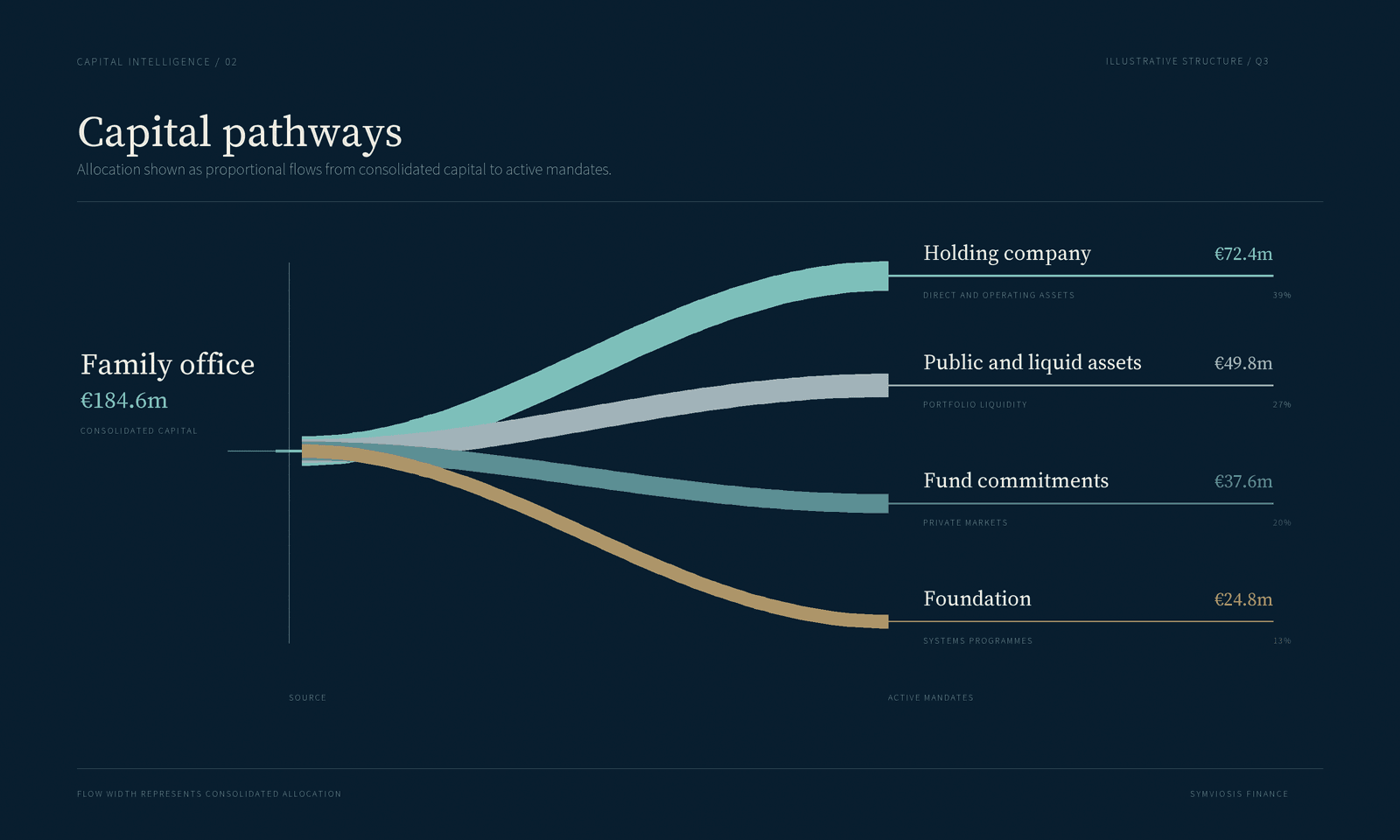
Consolidated capital€184.6mAcross six reporting entities
Mobilisable liquidity€21.8mTiming and constraints modelled
Active interventions12Investment · grants · influence
Evidence coverage87%Sources and assumptions retained
Illustrative pathways connecting family-office capital to holding companies, liquid assets, funds and a foundation
Commercial capitalScale
Patient capitalBuild
PhilanthropyExplore
InfluenceEnable
Office operating pictureConnected
Consolidated portfolios

Public, private, direct, real assets and philanthropic allocations.

Capital
Ownership and governance

Vehicles, mandates, approvals, responsibilities and follow-through.

Authority
Institutional memory

Decisions, assumptions, evidence and outcomes across generations.

Learning
One portfolio · one impact strategyLive context
Capital and commitmentsOwnership and entitiesGovernance and memoryOffice-controlled environment

Systems-change intelligence

Understand what keeps a problem in place.

W.AI.C maps actors, incentives, policies, markets, infrastructure, resource flows, behaviours, dependencies, power structures and narratives surrounding a problem.

Explore systems-change intelligence
I
System layer

Structural conditions

Policy · regulation · incentives · institutions · infrastructure · capital and resource flows

II
System layer

Actors, relationships and power

Decision rights · networks · dependencies · information asymmetries · coordination failures

III
System layer

Deeper conditions

Social norms · narratives · expectations · institutional assumptions · long-term behaviour

Housing affordabilityPreventive healthBiodiversityFood systemsEducationClimate adaptation

Proprietary world models

Model possible interventions before committing major resources.

W.AI.C is developing in-house world models for systems-change analysis. They combine available data, research, expert knowledge, system relationships and explicit assumptions to examine how different interventions could propagate.

Each scenario retains its evidence, assumptions and confidence, supporting better judgement under uncertainty and clearer decisions.

Explore world models and scenarios
Illustrative system questionRotterdam · housing

How could we materially improve affordable housing in Rotterdam?

Start with population need and housing supply, then compare direct provision with operator finance, enabling infrastructure, planning reform and coordinated capital.

01

Problem scale Need, geography, affordability threshold and time horizon.

02

System constraints Land, permits, construction economics, finance and capacity.

03

Possible roles Investor, guarantor, convener, operator, funder or policy partner.

Assumptions · evidence · confidence · open questionsEvidence-led scenario

Intervention depth

Compare what changes at every degree of action.

Move from a direct response to strategies that enable other actors, alter shared conditions and anticipate effects across connected systems.

01Direct action

Act on the problem

Fund, acquire or deliver the solution directly. Estimate capital, capacity, deployment time and people reached.

02Enabling action

Increase what others can do

Back proven operators, provide guarantees, finance infrastructure or coordinate capital around a shared vehicle.

03Conditions change

Alter what shapes many actors

Address rules, incentives, institutions, financing structures, procurement, coordination and public capacity.

04Systemic effects

Follow change across systems

Model feedback, spillovers, constraints and unintended effects across connected economic and social systems.

05

The Systems Change Planner

Turn an ambition into a working intervention strategy.

Define a geography, population, problem and desired outcome, then build the path from the current situation to organised action.

Explore the planner
I

Frame the ambition

01
Define the outcome

What should change, for whom, where, by how much and by when?

02
Establish the baseline

Quantify the problem, affected populations, current expenditure and trends.

II

Read the system

03
Map the system

Identify actors, incentives, constraints, capital flows, policies and dependencies.

04
Find intervention points

Locate where resources or coordination could alter important behaviour.

III

Design the intervention

05
Generate pathways

Compare direct action with progressively more systemic strategies.

06
Backsolve requirements

Estimate capital, people, expertise, partnerships, time and capability.

IV

Test and organise

07
Model consequences

Examine outcomes, downstream effects, dependencies and unintended change.

08
Build the plan

Convert strategy into actions, owners, milestones, decisions and partnerships.

V

Learn and adapt

09
Monitor the system

Follow indicators showing whether conditions and outcomes are moving.

10
Adapt

Update the plan as evidence, politics, markets and system behaviour change.

A multigenerational family and adviser working together around a stewardship plan

Family purpose in practice

Give every generation a meaningful role in the work.

Connect family knowledge, enterprise experience, philanthropic intent and professional advice around a shared view of the outcomes the office wants to advance.

Family intentEnterprise knowledgeImpact evidenceShared learning

An impact portfolio as a system

Coordinate investments, philanthropy and influence around shared outcomes.

Different forms of capital are useful at different points. Design them together, see where they reinforce one another and identify where more capital would have limited value.

01

Commercial investment

Scale solutions with durable economics.

02

Patient and catalytic capital

Build markets and absorb risks that constrain conventional investment.

03

Guarantees and blended finance

Remove constraints and mobilise larger pools of capital.

04

Philanthropy

Fund research, experimentation, convening and public goods.

05

Policy and influence

Change incentives and conditions affecting an entire field.

06

Coalition infrastructure

Coordinate the actors required for shared progress.

Multi-problem, multi-solution intelligence

Find interventions that address several problems at once.

Housing, health, climate, food, education and employment overlap. W.AI.C identifies shared causes, common actors, reinforcing interventions, policy dependencies and conflicting strategies.

Advanced due diligence

Understand the full financial, operational and system value of an opportunity.

Financial, commercial and operational diligence remains essential. W.AI.C adds system relevance, additionality, intervention logic, power, externalities and higher-order consequences.

Explore advanced diligence
01

System relevance

How important is the problem and where does the opportunity sit within it?

02

Additionality

Which outcomes are attributable to this capital or intervention?

03

Intervention logic

How does the organisation produce the claimed outcome?

04

Dependencies

Which policies, institutions, suppliers or behaviours must remain favourable?

05

Power and externalities

Does success distribute agency, concentrate it or move costs elsewhere?

06

Second-order consequences

What changes if the intervention succeeds at scale?

Measure what actually changes

Measure progress from activity to durable system change.

Track direct delivery, stakeholder outcomes, system conditions, durability and spillovers—then compare the original intervention thesis with what actually happened.

01

Outputs

What was funded, built or delivered?

02

Outcomes

What changed for people, communities or ecosystems?

03

Conditions

Did structures, relationships, power or mental models move?

04

Durability

Which conditions allow the change to persist and spread over time?

Impact FrontiersIRIS+Systems conditionsEvidence and learning

Human intelligence and coordination

Bring the right people into the problem—and give them a shared operating layer.

W.AI.C combines structured intelligence with the people who understand each city, sector, institution and community. The platform identifies missing knowledge, assembles the right expertise and coordinates action around clear roles and shared accountability.

A cross-disciplinary group discussing an impact and systems-change strategy
Expert roundtable

Financial, scientific, operational and local knowledge brought into one evidence-led process.

ResearchersScientistsIndustry specialistsEntrepreneursFund managersPolicy expertsOperatorsCommunity organisationsSystems practitionersLocal expertsInvestorsPhilanthropists
Working groupsMap responsibilityShare selected evidenceTrack commitmentsCoordinate fundingPreserve institutional memory

Inside the reports

Explore the detail behind the overview.

Preview three pages, then request the complete sample from our team.

A complete operating picture for a USD 230M family office

A 23-page operating case study showing the inherited complexity, first 90-day data foundation, family workshops, ownership mapping, governance, impact and systems-change work.

Sample
Family-office case study · Page 1 of 23 · Sample
Family-office case study: A complete operating picture
Preview 1 of 3 · 23 pages total
White architectural arch representing a private threshold

Private by design

Keep sensitive family, financial and systems intelligence under your authority.

Controlled access, source traceability and deployment flexibility form the foundation of the operating model.

01
Office-controlled data

The family determines who can access information and for which purpose.

02
Role-based permissions

Principals, teams, advisers, experts and partners receive distinct access.

03
Traceable evidence

Analysis remains connected to source documents, assumptions and decisions.

04
Controlled collaboration

Share selected information through precise, purpose-specific access.

Explore private technology
A family-business principal and trusted adviser reviewing a stewardship report

Human operating support

Work with people who understand both the family and the system.

Continuity across portfolio organisation, impact strategy, research, diligence, expert coordination, systems mapping, intervention design, reporting and follow-through.

01
Family-office context

Structures, mandates, objectives, governance and decision history retained.

02
Systems and impact practice

Research, mapping, modelling, measurement and learning around long-horizon objectives.

03
Execution continuity

Owners, partnerships, milestones, evidence requests and decisions carried forward.

Supporting dozens of impact networks and institutions

One question · a complete operating view

Bring the question that matters most to your office.

See the portfolio, evidence, relationships, decisions, impact objectives and system conditions around it in one governed view—then examine the opportunities, risks and next decisions that follow.

Confidential demonstration · shaped around your office and priorities